General Dentist · Dubai
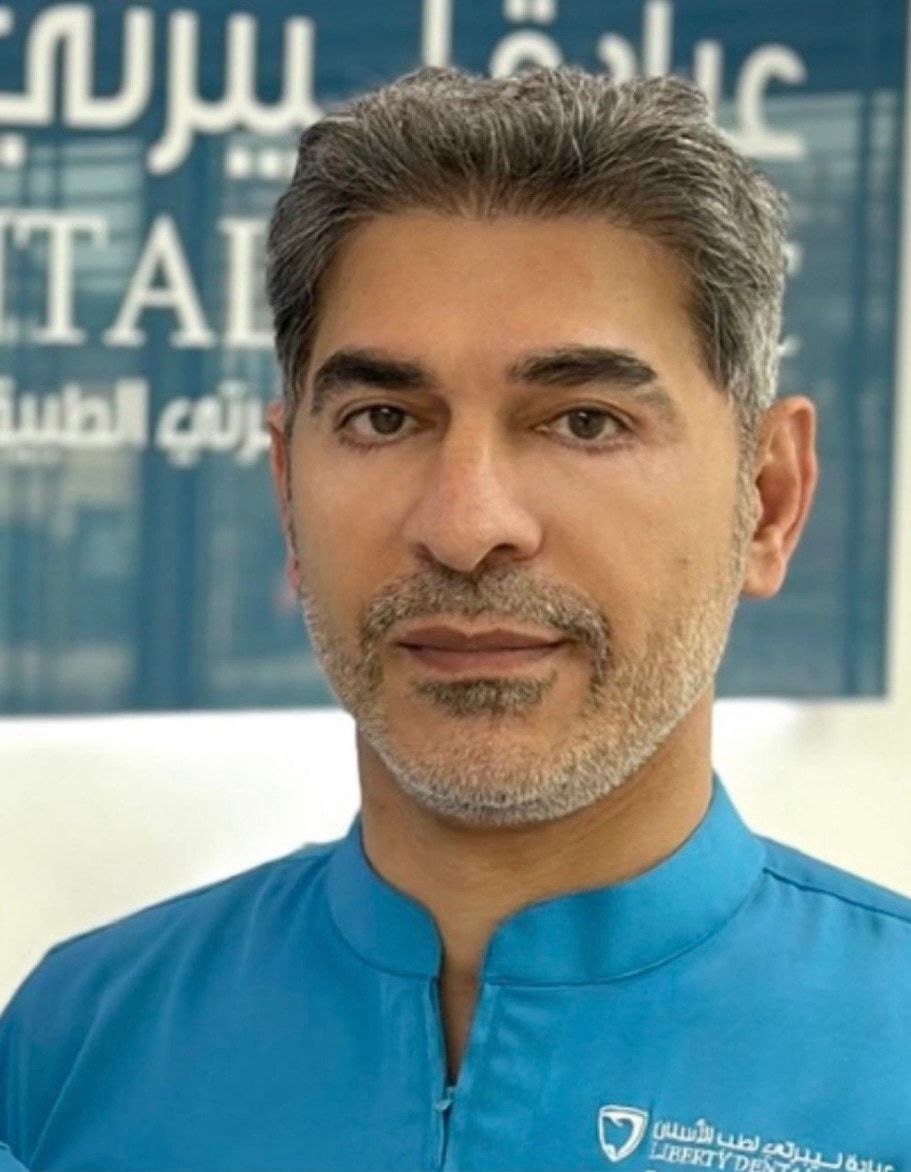
Dr Nazem Al Ioussef
A General Dentist with an Implantology Privilege, licensed by the Dubai Health Authority since 2011. He studied dentistry and oral surgery in Irkutsk, Russia, and has practised in Dubai since 1999.
Licence details
As listed in the Dubai Health Authority registry
- Licensed title
- General Dentist
- Clinical privilege
- Implantology Privilege
- Professional licence
- 00239613-001 · Dubai Health Authority (DHA)
- Consults at
- Liberty Dental Clinic, Jumeirah 3, Dubai
Appointments are arranged by Liberty Dental Clinic. +971 4 395 5009
Biography
About Dr Nazem Al Ioussef
Dr Nazem Al Ioussef graduated from Irkutsk State Medical Institute in 1995 with a Bachelor of Dental Surgery, then went on to postgraduate training in oral and dental surgery. His main clinical focus is dental implants, together with surgical work inside the mouth, such as removing impacted wisdom teeth, apicectomy and the removal of cysts.
He began practising in Dubai in 1999 and trained in the Department of Maxillofacial Surgery at Al Qassimi Hospital in 2005. He is licensed by the Dubai Health Authority as a General Dentist with an Implantology Privilege, has consulted at Liberty Dental Clinic since 2013, and speaks with patients in Arabic, English and Russian.
His main focus
How an implant is placed
A simplified drawing of what usually happens when a dental implant is placed in the jaw. Scroll to follow the steps in order.
A narrow drill
Once the area is numb and the gum is opened, a narrow drill makes a small starting channel in the bone, in the position and direction planned beforehand from X-rays.
Widening the channel
Slightly wider drills follow in turn, enlarging the channel a little at a time to the size of the implant, while water cools the bone as they work.
The implant goes in
The implant is a small screw-shaped post, usually made of titanium. It is turned into the channel until it sits firmly in the bone.
Bone grows onto it
Over time, bone grows onto the implant's surface and fuses with it. How long this takes differs from person to person.
Abutment and crown
Once the implant is fixed in the bone, a connecting piece called an abutment is attached, and a crown made to match the neighbouring teeth is fitted on top.
His clinical interests
Clinical interests
Dental implants first, with bone grafting and surgical work inside the mouth. Each page explains its subject in plain language, with a drawing and its sources.
- Main focus
Dental implants
How an implant replaces the root of a missing tooth, and what treatment usually involves. - Implantology
Bone grafting and sinus lift
When there is not enough bone to hold an implant, and how it is built up. - Oral surgery
Impacted wisdom teeth
Why wisdom teeth get stuck in the jaw, and when removal is considered. - Oral surgery
Exposing impacted teeth
When a tooth, often an upper canine, stays buried, and how it is uncovered and guided into place with a brace. - Endodontic surgery
Apicectomy
A small operation at the tip of a root, when infection remains after root canal treatment. - Oral surgery
Jaw cysts
Fluid-filled sacs in the jaw, often found on an X-ray, and how they are removed. - Oral surgery
Frenum surgery
Tongue-tie and lip-tie: when a tight frenum matters, and how it is released. - Gum surgery
Gingivectomy
When gum overgrows and covers part of a tooth: why it happens, and how the excess gum is removed. - Oral surgery
Small lumps in the mouth
Common harmless lumps inside the mouth, when to have one checked, and how one is removed.
Layer by layer
Beneath the surface
A tooth is built in layers, and each layer has its own problems and its own care. Scroll to see a molar in section, one layer at a time.
Enamel
Enamel covers the crown and is the hardest tissue in the body. It has no nerves, and what is lost does not grow back, so it is worth protecting with fluoride toothpaste and regular check‑ups.
Dentine and pulp
Beneath the enamel lies dentine, and at the centre of the tooth the pulp: nerves and blood vessels that run down a canal in each root. If decay or a crack reaches the pulp it can become inflamed or infected, and root canal treatment is one way to keep the tooth.
Gum and ligament
The gum wraps the neck of the tooth, and a thin ligament holds each root in its socket. Plaque left at the gum line can inflame the gum; untreated, the inflammation can spread to the ligament and the bone.
Jawbone
The roots sit in the jawbone. At the back of the mouth a wisdom tooth sometimes stays partly or fully buried in the bone, tilted against its neighbour.
When a tooth is lost
A dental implant is one way to replace the root of a lost tooth: a post, usually titanium, placed in the bone, which later carries a crown.
Everyday questions
Patient guides
Practical questions about teeth, answered in plain language from public health sources: from everyday cleaning and children's teeth to emergencies, X-rays and bad breath.
- Everyday care
Cleaning your teeth properly
Brushing, toothpaste and cleaning between the teeth: daily habits that protect teeth and gums. - Prevention
Tooth decay
How decay starts, how it progresses, and what stops it. - Gum health
Gum disease
From bleeding gums to periodontitis, and the daily care that helps prevent it. - Common symptoms
Sensitive teeth
Why teeth hurt with cold or sweet things, and what helps. - Inside the tooth
Root canal treatment
What happens inside a tooth when the pulp becomes inflamed or infected. - Repairing teeth
Crowns and bridges
How a weakened tooth is covered with a crown, and how a bridge fills the gap left by a missing tooth. - Urgent problems
Dental emergencies
What to do if a tooth is knocked out or broken, or the face swells, and when to call 998. - Urgent problems
Dental abscess
What a dental abscess is, why it needs prompt treatment, and when swelling is urgent. - Diagnosis
Dental X-rays and 3D scans
Why X-rays are taken, and what each kind of image shows. - Family health
Children's teeth
From a baby's first tooth to a first dental visit: teething, sugar and help with brushing. - Common symptoms
Bad breath
Where bad breath usually comes from, what helps, and when it needs a dentist. - Jaw and habits
Teeth grinding
Grinding and clenching, often at night: the signs, the causes and what can help. - Inside the mouth
Mouth ulcers
Why mouth ulcers appear, how to ease them, and when one needs checking.
Career
From Irkutsk to Jumeirah
Points in his career as recorded in his CV and in the Dubai Health Authority's medical registry.
- 1995Bachelor of Dental Surgery, Irkutsk State Medical Institute, Russia
- 1999Begins practice in Dubai at Al Mousa Medical Centre
- 2005Training in the Department of Maxillofacial Surgery, Al Qassimi Hospital
- 2011DHA licence: General Dentist, with Implantology Privilege
- 2013Liberty Dental Clinic, Jumeirah 3
Questions and answers
Questions people ask
How can I check his licence?
His licence appears in the Dubai Health Authority's public medical registry (Sheryan), with his licensed title, his privilege and the facility where he works. His professional licence number: 00239613-001
Which languages does he speak with patients?
Arabic, English and Russian.
How are appointments arranged?
Appointments are arranged by Liberty Dental Clinic, not through this site. The clinic's telephone number: +971 4 395 5009
Is this site for emergencies?
No. In a medical emergency in the UAE, call an ambulance on 998. The dental emergencies guide explains what to do if a tooth is knocked out or the face swells.